
Scaling agentic AI: from prototypes to platforms
While building individual AI agent prototypes is relatively easy, scaling them across an organization requires strong governance, security, observability, and centralized management. A platform-driven approach enables companies to deploy, monitor, and improve AI agents at scale, turning isolated experiments into a coordinated digital workforce.
Scaling agentic AI: from prototypes to platforms
Introduction
Artificial intelligence is no longer just about chatbots or predictive analytics, it’s about digital colleagues that integrate seamlessly into your workflows, take initiative, and drive measurable outcomes. These AI agents don’t just respond to commands; they perceive their environment, reason through complex tasks, and act autonomously to deliver value. Yet, while the potential is enormous, most organizations struggle to move beyond isolated prototypes. The real challenge isn’t building an AI agent, it’s scaling it across an enterprise without creating chaos.
In a recent webinar, we cut through the hype to explore how businesses can harness agentic AI at scale. They shared practical steps, real-world examples, and lessons from early adopters, revealing why a platform-driven approach is critical for turning AI experiments into reliable, enterprise-grade solutions.
This article breaks down the key takeaways from the webinar, from understanding the fundamentals of AI agents to implementing a scalable platform that ensures security, governance, and continuous improvement. Whether you’re exploring your first AI use case or looking to expand a fleet of digital workers, you’ll learn how to avoid common pitfalls and build a future-ready AI strategy.
Agentic AI 101: What are AI agents?
AI agents mark a significant evolution from traditional AI tools. While conventional AI systems are often limited to reactive, task-specific functions, like answering questions or processing datasets, AI agents operate as proactive, autonomous digital colleagues. They are designed to integrate into workflows, take initiative, and deliver outcomes that align with business goals.
At their core, AI agents are defined by their ability to:
- Perceive their environment by understanding user inputs, accessing data, or monitoring systems.
- Reason through information to analyze patterns, solve problems, and make decisions.
- Act independently by executing tasks, interacting with tools, and communicating with users.
- Learn and improve continuously through feedback and real-world experience.
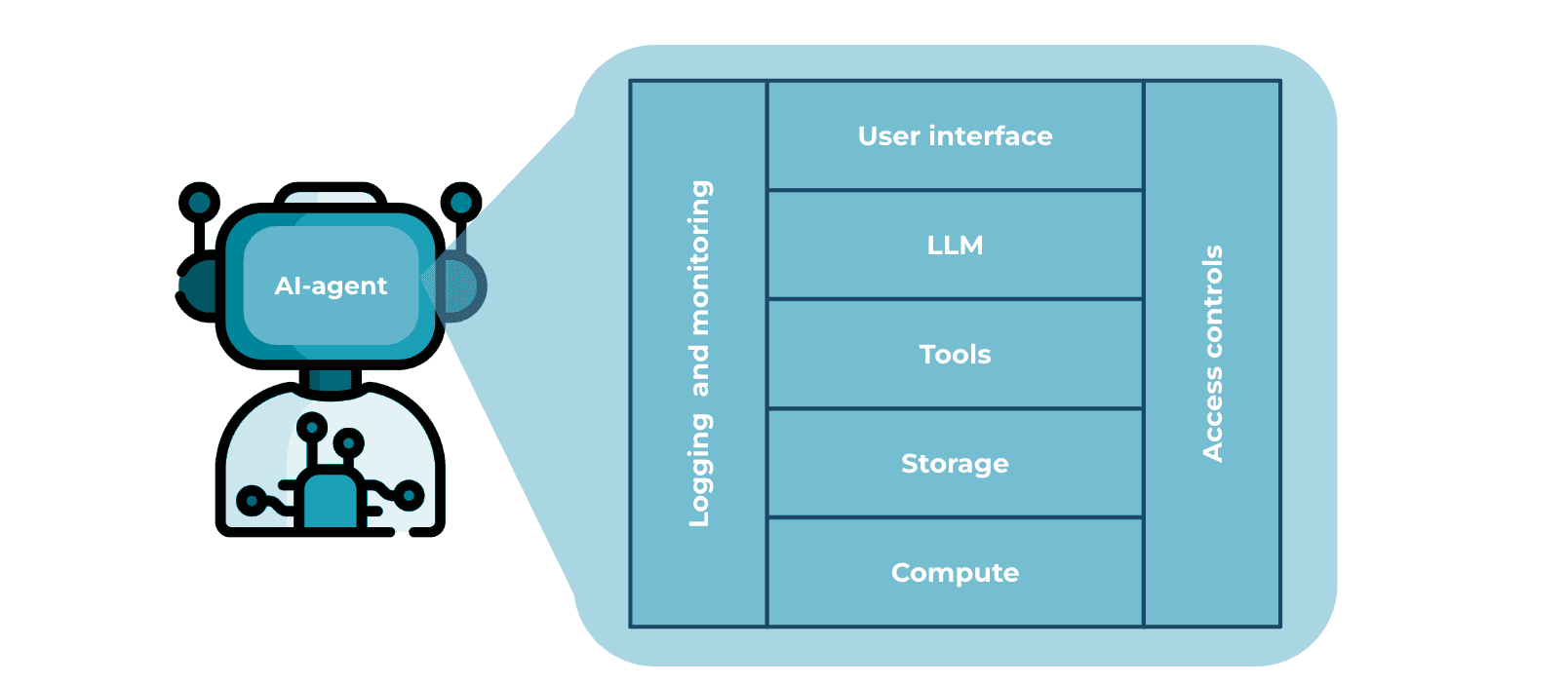
This combination of capabilities allows AI agents to go beyond simple automation. They are built with a robust architecture that typically includes logging and monitoring, user interfaces, access controls, large language models (LLMs), tools, storage, and compute resources. These components enable them to function seamlessly within existing processes, adapting to new challenges and collaborating with human teams.
What truly distinguishes AI agents is their capacity to drive meaningful change. They don’t just perform isolated tasks; they handle end-to-end processes, refine their performance over time, and act as reliable partners in achieving business objectives. Whether deployed in customer service, sales, compliance, or operations, AI agents bring a new level of autonomy and intelligence to automation. By acting with context, initiative, and adaptability, they redefine what it means to leverage AI, transforming it from a supportive tool into a strategic asset that evolves alongside your organization.
Real-world applications: where are AI agents used today?
AI agents are already delivering measurable value across industries, automating workflows, enhancing decision-making, and driving efficiency.
In customer support, AI agents are revolutionizing high-volume operations. For instance, CDON and Fyndiq, two leading Nordic marketplaces, use AI agents to manage thousands of customer cases each week. These agents coordinate between customers, merchants, and logistics partners, ensuring faster, more accurate, and consistent resolutions without increasing operational costs or staffing. As one executive noted, the transition from discussion to a functional AI colleague happened in just weeks, demonstrating the technology’s ability to evolve in real time and build trust among teams.
For compliance and risk management, AI agents continuously review supplier data, certifications, and transactions to identify gaps, missing documents, or potential risks. This proactive monitoring helps businesses stay ahead of regulatory requirements and avoid costly oversights.
In sales and CRM automation, AI agents take over manual tasks such as updating customer records, tracking interactions, and generating reports. They can automatically summarize weekly sales data, extract key insights, and flag unusual trends, enabling sales teams to focus on strategy and customer relationships rather than administrative work.
Field service operations benefit from AI agents that invoice customers immediately upon completion of assignments, based on predefined agreements and terms. This not only accelerates cash flow but also reduces revenue leakage by eliminating delays and errors in billing.
Financial teams are leveraging AI agents as financial clerks to read, interpret, and analyze monthly reports from portfolio companies. By automating these time-consuming tasks, agents free up financial professionals to concentrate on higher-value analysis and decision-making.
 These examples underscore a key trend: AI agents are not just replacing repetitive tasks, they are augmenting human capabilities, enabling businesses to operate more efficiently and strategically. By integrating into existing workflows, they act as force multipliers, allowing teams to focus on innovation and growth while the agents handle the routine.
The gap: why prototyping is easy, but scaling Is hard
Building a single AI agent prototype is a straightforward process, many teams can develop a functional agent in just weeks. The real challenge begins when organizations attempt to scale these agents across multiple workflows, teams, and systems.
As we said in the webinar: “Prototyping an AI agent is relatively easy. Scaling is where things get tricky. Without a structured approach, businesses often encounter a host of complexities that turn initial success into operational chaos.”
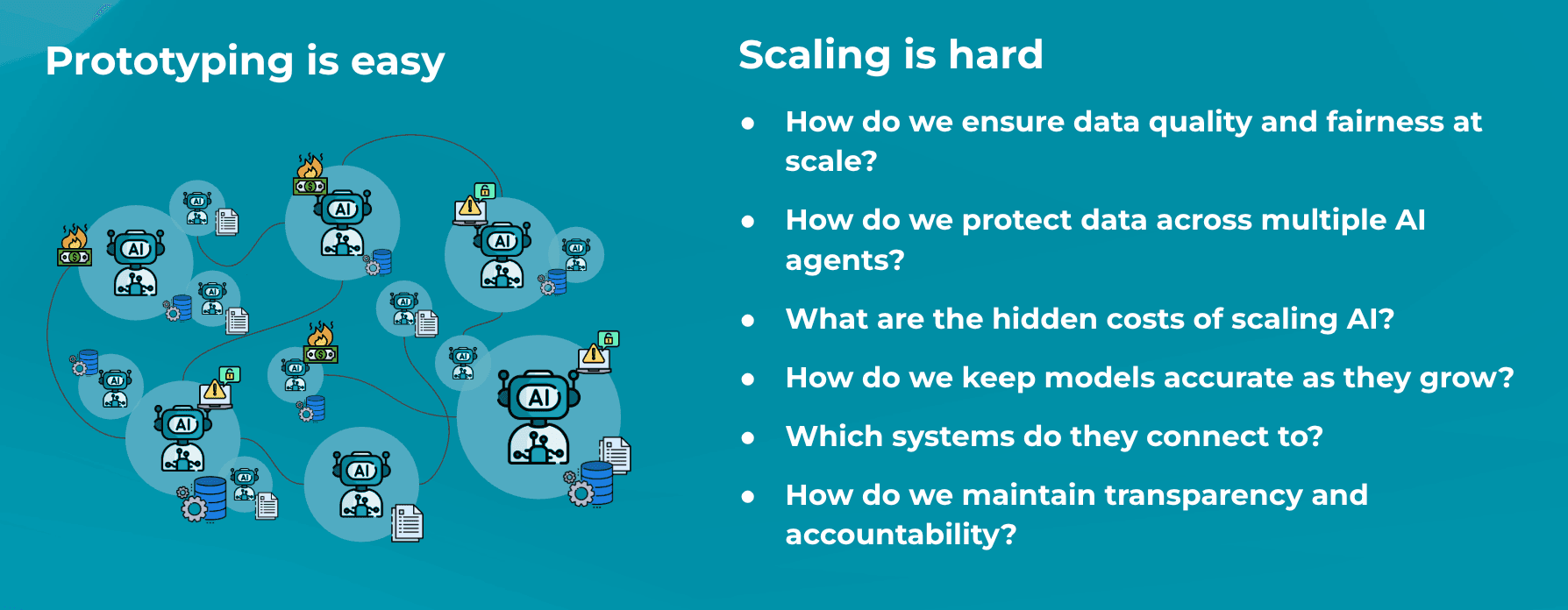
Common challenges in scaling AI agents:
-
Data quality and fairness at scale Prototypes typically operate in controlled environments with curated datasets. However, scaling introduces variability in data sources, quality, and bias. Ensuring consistency, accuracy, and fairness across hundreds or thousands of interactions becomes a significant hurdle. Poor data quality can lead to unreliable outputs, eroding trust in the system and creating compliance risks.
-
Security and privacy risks Scaling AI agents means expanding their access to sensitive data and systems. Without robust governance, this increases the risk of data leaks, unauthorized access, or misuse. Enterprise-grade security, such as identity management, encryption, and access controls, must be baked into the platform from the start. Algorithma’s platform addresses this by enforcing data protection by design, including data minimization, pseudonymization, and strict access controls, ensuring that personal and sensitive information is handled responsibly throughout its lifecycle.
-
Hidden costs and model accuracy The costs of running AI agents at scale, such as compute resources, API calls, and maintenance, can spiral if not carefully managed. Additionally, as agents interact with more diverse inputs, maintaining model accuracy and performance becomes increasingly difficult. Without real-time monitoring and continuous improvement mechanisms, agents may degrade over time, leading to inconsistent or incorrect outcomes.
-
Transparency and accountability As the number of agents grows, so does the complexity of tracking their actions, decisions, and impacts. Organizations need immutable audit trails, clear ownership, and centralized observability to ensure accountability. Algorithma’s Agent Management Suite provides real-time visibility into agent activity, performance, and costs, along with tools for prompt management, session logging, and performance reviews. This transparency is critical for identifying regressions, detecting anomalies, and maintaining compliance.
-
Integration and fragmentation Scaling often leads to fragmented agents scattered across different tools and teams, creating operational blind spots. Without a unified platform, managing updates, security patches, and integrations becomes cumbersome. Algorithma’s approach emphasizes a single management layer for all agents, enabling centralized control, standardized governance, and seamless integration with existing workflows, all while operating behind the organization’s firewall Agent Platform.pdf.
The transition from prototype to scale requires more than just technical solutions; it demands a shift in mindset. Organizations must prioritize governance, observability, and incremental scaling. By starting with high-impact, low-complexity use cases and designing for human collaboration, businesses can build trust and demonstrate value before expanding. A platform-driven approach, like we discussed in the webinar, turns chaos into control, providing the tools and structure needed to deploy, monitor, and improve agents at scale.
The role of an agentic AI platform: your control center for scaling AI agents
Scaling AI agents from prototypes to enterprise-wide deployment requires more than just technology. It demands a unified, secure and observable platform that acts as the operating system for your digital workforce. Without it, organizations risk fragmented agents, security gaps and operational inefficiencies that can undermine the promise of AI automation.
A platform is essential for turning chaos into control. It provides a single, centralized environment to deploy, host and manage all your AI agents, ensuring they operate as a cohesive digital team rather than isolated tools. This unified approach eliminates operational blind spots, reduces complexity and enables seamless integration with existing workflows, all while maintaining enterprise-grade security and compliance.
Key benefits of a platform approach
-
Unified management: Deploy, monitor and govern all agents from one place, avoiding the inefficiencies of scattered tools and teams.
-
Enterprise-grade security: Built-in protections, such as strong identity management, network isolation and least-privilege access, ensure that agents operate securely behind your firewall, with security tailored to each use case.
-
Real-time observability: Gain visibility into agent activity, performance, cost and quality through centralized dashboards. This allows teams to catch regressions early, track key metrics and maintain accountability.
-
Reusable building blocks: The platform’s agent factory enables rapid configuration of new agents using pre-built templates and integrations, reducing development time and ensuring consistency across deployments.
-
Governance and compliance: Immutable audit trails, standardized policies and a registry of record map every agent to its owner, version and lifecycle, making compliance and oversight effortless.
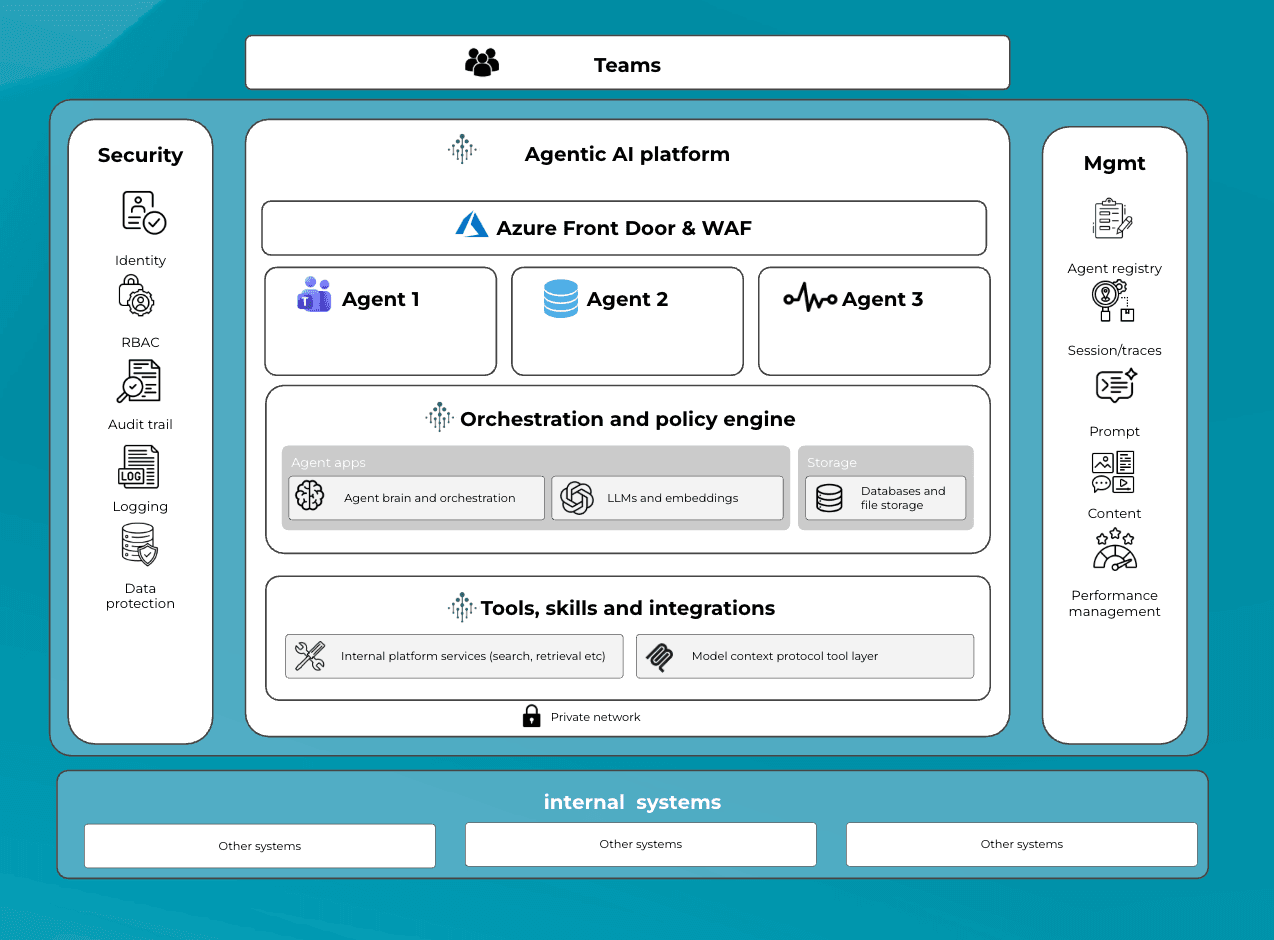
Our agentic AI platform is designed to be the control center for your digital workforce. It combines a robust management suite with a cloud-native architecture, ensuring scalability, security and continuous improvement. Core features:
-
Centralized dashboard: The home dashboard rolls up real-time activity across all agents, providing a quick view of volume, latency, cost and quality signals. Trend visibility helps teams spot regressions early, while shared metrics foster alignment between business and technical stakeholders.
-
Session and trace management:
- Sessions group related events, such as full user conversations, into a single thread, enabling business-friendly reporting on resolution rates, escalations and time-to-close.
- Traces capture a complete record of each agent run, including inputs, outputs, timing and cost. This supports root-cause analysis, performance accountability and compliance audits.
-
Prompt and content management: Create, version and govern prompts and business knowledge in a centralized repository. Versioning and labeling ensure safe iteration, while standardization reduces duplication and improves consistency across agents.
-
Agent registry: A lightweight source of truth that maps vendor agent identities to human-friendly names, simplifying governance and ownership. This normalization is critical for managing diverse agents, whether built in-house, onboarded from external sources or integrated from platforms like Microsoft Copilot.
-
Performance reviews: Structured evaluations turn raw data into actionable insights, highlighting strengths, areas for improvement and notable incidents. This outcome-first approach focuses on what matters most: quality, compliance, efficiency and user satisfaction.
-
Bring your own agent (BYOA): The platform supports any agent or tool that adheres to its standards, allowing organizations to onboard legacy or third-party agents without sacrificing oversight or control.
The platform is built on a cloud-native architecture, favoring managed services and simple, scalable components. Security is embedded at every layer:
- Data protection: Policies and mechanisms control how personal and sensitive data is collected, stored and used, with encryption, redaction and strict retention rules.
- Isolation and access control: Agents operate within private subnets, with least-privilege access to cloud services and robust logging for observability.
- Compliance-ready: Algorithma’s architecture aligns with zero-trust principles, ensuring that sensitive systems remain protected while agents interact with existing workflows.
A platform isn’t just about managing agents. It’s about enabling safe, stepwise scaling. By standardizing security, governance and observability, organizations can confidently expand their use of AI agents, from a single prototype to hundreds of digital colleagues. With Algorithma’s management suite, businesses gain the tools to monitor, improve and govern their agents, turning AI from an experimental tool into a strategic asset that drives measurable outcomes.
From experiments to adoption: lessons from early adopters
Moving from AI experiments to full-scale adoption requires a strategic approach that balances ambition with pragmatism. Early adopters of agentic AI have shown that success depends on starting small, designing for scale, and fostering collaboration between humans and digital colleagues. Here’s how to make the transition effectively:
The key to successful adoption is to begin with high-impact, low-complexity use cases where you can create quick wins and build trust. Focus on processes with clear responsibilities and predictable inputs and outputs. For example, automating routine customer support inquiries or standardizing internal reporting can deliver immediate value while demonstrating the potential of AI agents. These early successes help secure buy-in and funding for more ambitious projects.
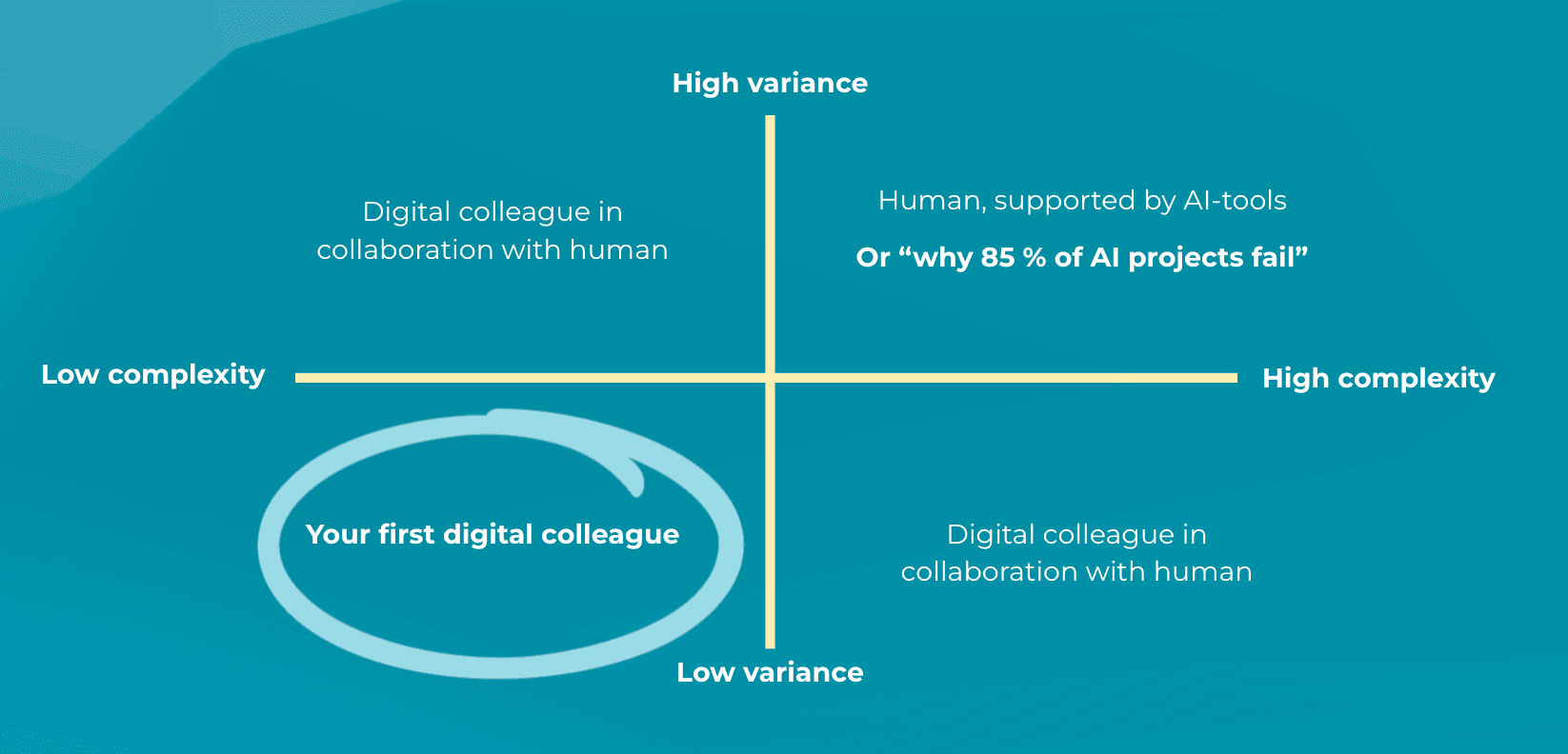
Break workflows into structured steps and let the agent handle those first. This approach not only builds confidence but also provides a foundation for scaling. Algorithma’s platform supports this by offering reusable components and integrations, allowing teams to configure new agents quickly without starting from scratch each time.
AI agents should not operate in isolation. Define escalation paths and review loops from day one to ensure seamless collaboration between digital and human teams. For instance, an AI agent handling customer inquiries should know when to escalate complex issues to a human representative. This hybrid model ensures that agents augment human capabilities rather than replace them, leading to better outcomes and higher acceptance among employees.
Begin by targeting internal processes where efficiency gains can be clearly measured. Whether it’s reducing response times in customer service, automating data entry in finance, or streamlining HR workflows, focus on areas where AI can deliver tangible improvements in speed, accuracy, and cost reduction. These efficiencies create proof of concept, build trust, and provide the momentum needed for broader adoption.
Adoption is not a one-time event but an ongoing process. Use feedback and performance data to refine your agents over time. Algorithma’s management suite provides tools for monitoring agent performance, tracking key metrics like latency and user satisfaction, and making data-driven improvements. Regular performance reviews and updates ensure that agents evolve alongside your business needs.
Before scaling, ensure you’ve addressed the following:
- Clear objectives: Align agent goals with business needs, focusing on measurable outcomes such as cost reduction, revenue growth, or risk mitigation.
- Governance and compliance: Assign ownership and enforce security and privacy regulations to maintain accountability.
- Performance metrics: Track key indicators like resolution rates, user satisfaction, and operational efficiency to gauge success.
- Integration plans: Ensure seamless compatibility with existing systems and tools to avoid disruptions.
- Team readiness: Train your team and assign accountability to drive adoption and maximize the value of your AI agents.
Scaling AI agents is an iterative process. Start with a pilot project in a controlled environment to validate your approach, then gradually expand to more complex use cases. Use session logs, performance feedback, and user insights to refine your agents and address any challenges that arise. This iterative approach allows you to scale confidently while minimizing risk.
By following these lessons from early adopters, organizations can transition from experimentation to full-scale adoption, unlocking the full potential of agentic AI to drive innovation and growth.
Next steps: turning agentic AI into action
Agentic AI is more than just a technological advancement; it’s a transformative force that is reshaping how businesses operate. From automating routine tasks to acting as proactive digital colleagues, AI agents offer unprecedented opportunities for efficiency, innovation, and growth. However, realizing this potential requires more than just building individual agents, it demands a structured, platform-driven approach that ensures scalability, security, and continuous improvement.
The journey from experimentation to full-scale adoption begins with a clear strategy: start small, focus on high-impact use cases, and design for collaboration between humans and AI. A unified platform, like Algorithma’s, provides the tools to deploy, manage, and govern agents effectively, turning fragmented prototypes into a cohesive digital workforce.
As you embark on this journey, remember the guiding principle shared during our webinar: “Start where control is high, create control where it’s missing, and scale from there.”
For a deeper dive into how agentic AI can drive value for your organization, watch the full webinar here. Discover practical insights, real-world examples, and actionable steps to put AI to work at scale.